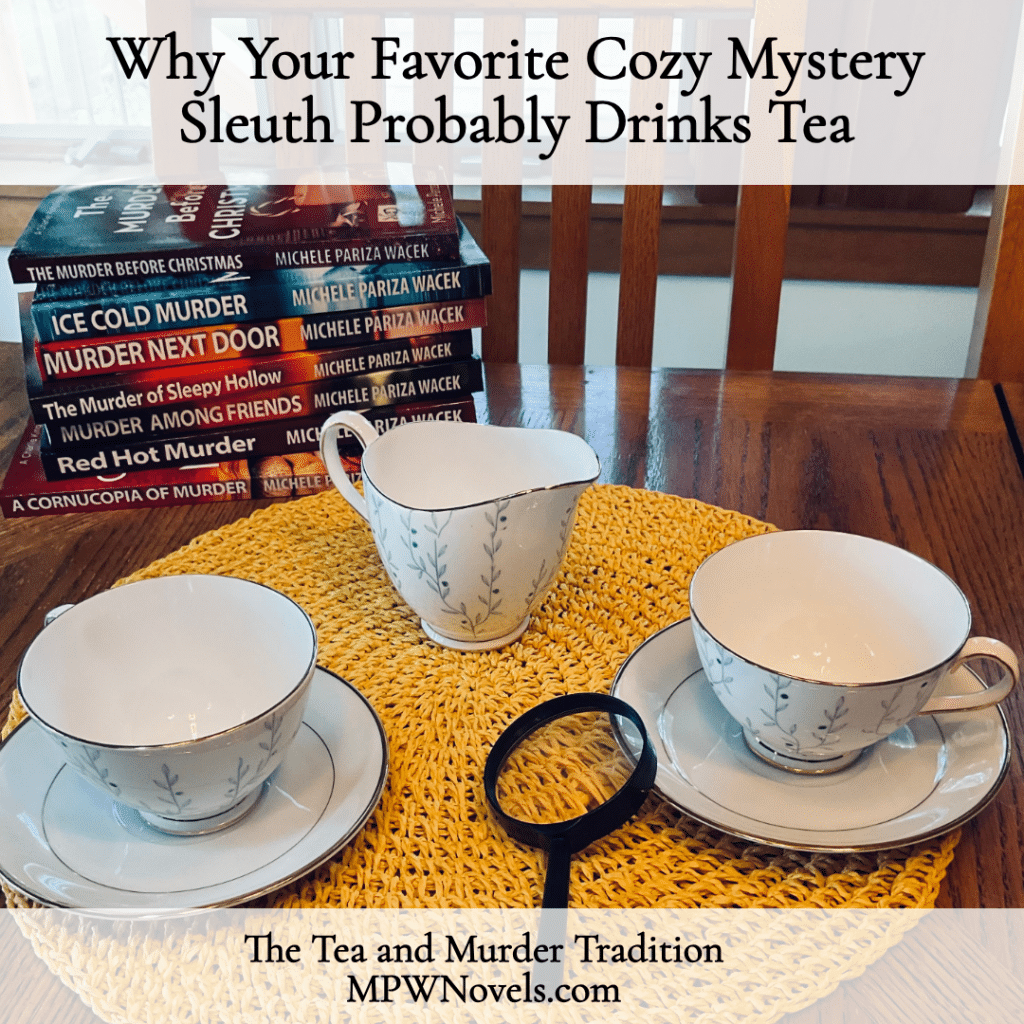
Here’s a small observation. The next time you pick up a cozy mystery, count the scenes that involve a kettle. Or a teapot. Or someone offering someone else a cup of something hot. You’ll lose count before you finish the book.
This is not an accident. Tea and cozy mysteries have been keeping company for nearly a century, and there are real, structural reasons why.
Tea is the prop that lets the interrogation happen
Cozy mystery sleuths are not police. They don’t have badges. They can’t compel anyone to answer questions. So how do they actually find anything out?
They invite someone over for tea.
A cup of tea is a social contract. When you accept one, you’ve also accepted, at minimum, the next twenty minutes of conversation. The sleuth pours, the suspect settles in, and somewhere between the first sip and the second, the question that cracks the case gets asked — usually disguised as something innocent. Oh, I didn’t realize you were at the church that night. What time did you leave?
This is the structural genius of cozy mysteries. The interrogation doesn’t look like an interrogation. It looks like hospitality. And tea is what makes that work.
Tea makes the sleuth approachable
Miss Marple solved an absurd number of murders for an elderly woman in a small English village. She did it partly because no one ever suspected her of investigating anything. She was just the nice old lady offering tea and asking polite questions.
Modern cozy sleuths use the same trick. A baker, a librarian, a knitter, an herbalist — these are not threatening figures. They’re the people you tell things to. And when one of them happens to also be solving a murder on the side, the suspect doesn’t tighten up the way they would around a detective. They keep talking. They keep accepting the tea.
Tea slows the pace down so the clues can land
Cozy mysteries are not thrillers. They’re not built on speed. They’re built on observation — small details, casual remarks, a glance that goes on a beat too long. For those details to register with the reader, the scene needs room to breathe.
Tea is how that happens. A scene set over tea has natural pauses built in — the kettle, the pouring, the sipping. Each pause gives the reader a chance to catch the thing the sleuth just noticed. It’s pacing in a teacup.
Tea is the genre’s love language
There’s a reason “cozy” is the right word for the genre. These are books that comfort you while you read them. They’re set in small towns where people know each other’s names. They feature found families, beloved pets, and meals shared at kitchen tables. The villain gets caught. The world rights itself by the last page.
Tea fits all of that. It’s warm. It’s familiar. It’s something you make for someone you care about. When a cozy mystery character offers tea, what they’re really saying is I see you, sit down, you’re safe here for a minute. Even if the next scene contains a murder.
Which brings us to Charlie Kingsley
Charlie Kingsley is the protagonist of a nine-book cozy mystery series set in 1990s small-town Wisconsin. She’s an herbalist by trade, which means she actually makes tea for a living — and her teas are arguably the most important props in the books. Pretty much every case has someone either showing up at Charlie’s kitchen table for a cup or Charlie bringing the tea to them. And, of course, most of the cases end with a cup (and a homemade treat).
The teas in the Charlie Kingsley books are real. They’re blended to Charlie’s specifications and available at Charlie’s Concoctions — Lemon Lavender for anxiety, Deep Sleep for the long nights, and Candy Cane Concoctions for December. They’re the same teas the characters drink in the books.
If the tea-and-murder tradition has appeal, Charlie’s series is a good place to settle in.